What is a personality assessment, and when does it work?
Employee personality testing has become ubiquitous in organizations. You’ve likely taken at least one or two personality assessments in the workplace as part of applying for a job, organizational training, or a leadership development program and have a collection of letters, numbers, or colors that claim to describe who you are. At least one employee personality assessment may have resonated with you, while others may have seemed more like horoscopes (and those are just the ones you remember). Have you ever wondered what a “workplace personality assessment” actually tells you, how such assessments are best used, or the “right” way to take personality assessments in the workplace? This post will explain what personality testing for employees aims to do, how such assessments are useful, and when they can be valuable tools for individual and team development.
What is personality?
First, what exactly do these psychological personality assessments in the workplace claim to measure? Personality is defined in many ways. One of the more comprehensive definitions is provided by Randy Larsen and David M. Buss: “the set of psychological traits and mechanisms within the individual that are organized and relatively enduring, and that influence his or her interactions with, and adaptations to, the intrapsychic, physical, and social environments.” (p. 4). This seemingly complex definition illustrates how personality is more complicated than the typical list of traits or types that we usually associate with the term. For example, personality is more than just whether you are an extrovert or an introvert. In fact, most people are not only one or the other, but some of both in varying degrees. The overarching concept of personality reflects relatively stable individual differences in how people think and behave in similar situations.
The often overlooked part of the definition is that personality isn’t just about observable behaviors; it also includes patterns of thinking that influence how people understand the world around them. For example, two people could walk away from the same interaction with a completely different understanding of what happened. Objectively, they had a conversation about potential ways to approach a new project they are working on together. However, the more result-oriented person leaves the interaction energized by a lively debate and satisfied that they decided on a better idea than they could have come up with individually. The other is more people-oriented and is worried about how that “fight” could impact the working relationship.
For people who have taken a popular employee personality assessment, the experience might have made them think these examples represent different “types” of people. The person who cares more about the product is the type [insert letter/number/color/animal]. The person who cares more about human interaction is the type [insert different letter/number/color/animal]. However, most research does not support the existence of distinct “types” of people. A continuum better represents personality traits. People are not “an extravert” or “an introvert,” for example. They fall somewhere between those two extremes. So why do so many people talk about personality types? Understanding that others have consistently different preferences than our own, referred to as a theory of mind, is crucial for everyday social interactions. Personality types are useful for developing a theory of mind and more respectful exchanges, but they can be detrimental if you use them to define people.
How is personality measured?
Typically, personality assessments in the workplace ask how well a list of adjectives (e.g., adventurous, anxious, outgoing) or statements (e.g., “I like to be the life of the party”) describes you. Although you are probably most familiar with these types of self-report questionnaires, there are several ways to assess the personality of candidates and/or employees in your company. There is also a range of types of personality tests for employment.
Unlike self-reported questionnaires, 360-type questionnaires ask the same questions to observers who know the individual they are assessing. Why ask others instead of the individual? Personality data provided by observers have a stronger relationship with job performance and thus lead to better insights than similar self-reported data. However, collecting responses from several other individuals isn’t always feasible.
Many approaches to personality measurement don’t rely on questionnaires. One is collecting test data or placing professionals in a standardized situation and evaluating their response. For example, you could assess someone’s patience by placing them in a position where they have to interact with someone who might not seem to understand the task at hand (someone you have instructed to act oblivious). Another type of personality assessment is to use physiological indicators such as fMRI results or eye movement. There are even those who examine social media posts as a means to shed light on various dispositional elements.
A variety of different self-report measures of personality exist. Among them are the typical adjective checklists (check which is like you) and Likert ratings (e.g., select strongly agree, agree, neither agree nor disagree, disagree, or strongly disagree), and there are psychology-based methods designed to decrease bias in self-report. For example, forced-choice assessments require respondents to share which of a set of words/statements is most like them instead of letting them rate each statement separately. For example, are you more realistic or inventive? The forced-choice method keeps respondents from indicating high levels across all socially desirable personality traits. Another self-report format is the conditional reasoning test. This method presents “logical reasoning problems” (meaning respondents are not told it measures personality) and asks respondents to choose one of four responses. Two responses are intentionally nonsensical, one reflects the measured personality trait (e.g., aggression), and the other is for people who are low on that trait. Yet another type of self-report method is rapid response measurement. This method incorporates how quickly people associate adjectives as accurate descriptors of themselves to determine the attribute’s importance and reduce conscious faking.
Finally, there are unstructured and projective measures that rely on an expert to score vague responses and identify their meaning. The most well-known example of a projective measurement is the Rorschach test. A trained evaluator shows the respondent several images and asks them to describe what they see. The evaluator uses these descriptors to determine personality traits.
Each method of measurement has pros and cons. Utilizing multiple measurement methods can provide a more accurate assessment by finding traits that are supported by more than one measure. Ultimately the types of personality tests for employment depend on the purpose of the assessment and the time and resources available.
How to take a personality test?
You might have ended up on this page because your employer or potential employer requires you to take a personality assessment test for employment, and you are looking for the “right” answer. If you are wondering “how to take a personality test, ” you are asking the wrong question. None of the methods to measure personality described in the previous section are tests, despite some that are labeled “tests.” They are actually “assessments,” and the difference is more than just a matter of one’s preferred word. Tests determine the degree of comprehension/understanding for a variety of domains (e.g., calculus, business terminology, or geologic formations) while assessments are ways to quantify characteristics like perceived organizational support or engagement that can’t be measured in a physical sense like height or mass.
When measuring someone’s height, we don’t turn to an answer key for the “right” response — we acknowledge that we could give an incorrect value for their height, and we acknowledge that someone could say a different number than their true height, but the point is that the only “right” answer is the true height of the person. This is similar to personality assessment, in that the only “right” answer that a person can give is the truthful one; it is dissimilar to a test of knowledge of calculus, as in that case the “right” answer is independent of the test taker. In personality assessment particularly, it is of great importance that the respondent provides (and is supported in providing and encouraged to provide) a truthful answer to the questions being posed, as only this way can we help individuals understand their own and others’ personalities. Immense gains can be achieved via understanding one’s own personality and the personalities present in one’s coworkers/managers/subordinates–this is why Tilt365 published assessments such as the True Tilt Personality Profile™ (TTP), the Positive Influence Predictor™ (PIP), and the Team Climate Profile™ (which will soon be replaced by the Team Agility Predictor™). Please see the end of this blog for more information on these assessments.
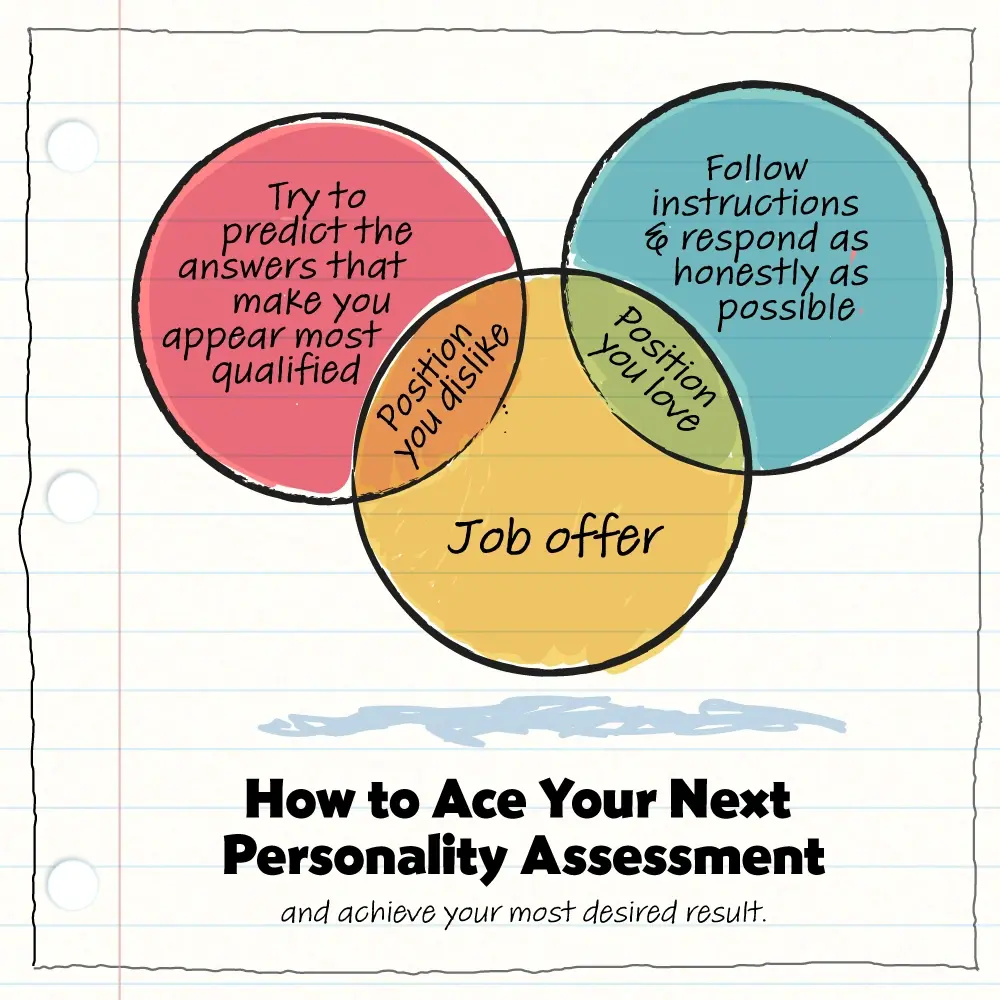
The best way to complete a personality assessment for employees is to follow the instructions, respond to the assessment as honestly as possible, and choose responses that reflect traits that have been relatively stable for you over time and across most contexts (as opposed to the unusual way that you may be feeling or thinking on a particular day that you’re taking the assessment). An alternative way to think about this is to strive to answer personality assessment items in such a way that your responses reflect dominant personality themes over the course of your life.